CNC TECHNICAL GUIDE
What Is a Bearing? Types, Functions and How to Choose One
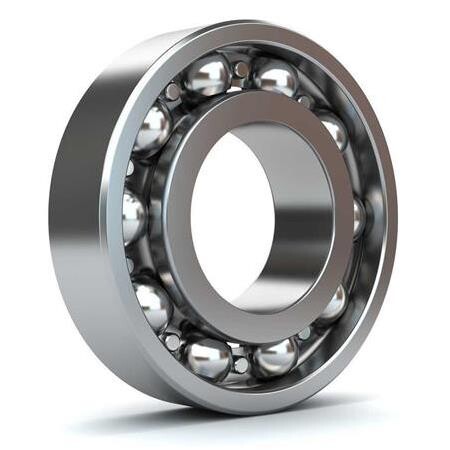
A bearing supports and guides relative motion between machine components while reducing friction. Bearings are used in motors, spindles, gearboxes, rollers, conveyors, pumps, CNC machines and countless other mechanical systems.
What does a bearing do?
A bearing can support radial load, axial load or a combination of both. It also helps maintain shaft position, control friction and provide predictable rotational or linear motion.
Main bearing families
Deep-groove ball bearings
Common general-purpose bearings that handle radial load and moderate axial load in both directions. They are widely used in electric motors and machinery.
Angular-contact ball bearings
Designed to carry combined radial and axial loads. They are frequently used in machine-tool spindles and other applications where axial stiffness matters.
Cylindrical roller bearings
Use cylindrical rolling elements and provide high radial load capacity. Depending on the design, axial movement may be permitted or constrained.
Tapered roller bearings
Designed for combined radial and axial loads. They are commonly used where preload or adjustable internal clearance is required.
Self-aligning bearings
Allow limited angular misalignment between the shaft and housing and can be useful where mounting or shaft deflection creates alignment variation.
Linear bearings
Guide straight-line motion on shafts or rails. CNC systems may use recirculating linear guide blocks, round-shaft bushings or other linear bearing technologies.
Radial load and axial load
Radial load acts perpendicular to the shaft axis. Axial load acts parallel to the shaft axis. The load direction and magnitude are fundamental inputs when choosing a bearing type.
Important selection factors
| Factor | Why it matters |
|---|---|
| Load magnitude and direction | Determines bearing family and size |
| Rotational speed | Affects heat, lubrication and permissible bearing design |
| Required stiffness | Important for spindles and precision motion |
| Misalignment | May require self-aligning geometry |
| Environment | Dust, moisture and contamination influence sealing |
| Temperature | Affects lubricant and internal clearance |
| Mounting fits | Influence internal clearance and ring creep |
Open, shielded or sealed?
Open bearings provide direct access to the rolling elements and are suitable where external lubrication and clean conditions are controlled. Metal shields help reduce entry of larger contaminants with low friction. Contact or non-contact seals provide greater contamination protection but can influence friction and speed capability.
Bearing clearance and preload
Internal clearance is the available movement between rings before mounting. Fits, temperature and operating conditions change the effective clearance. Some precision applications use preload to increase stiffness and control movement, but excessive preload creates heat and reduces bearing life.
Lubrication
Correct lubricant type, quantity and relubrication interval are essential. Too little lubrication can cause metal contact and wear; too much grease can increase churning losses and temperature.
Bearings in CNC machines
CNC systems use bearings in spindles, servo motors, ball-screw supports, rotary axes and linear-motion assemblies. Bearing selection in these applications must consider accuracy, stiffness, speed and thermal behavior as well as static load capacity.
Common causes of early bearing failure
- Contamination
- Incorrect mounting force
- Misalignment
- Insufficient or excessive lubrication
- Incorrect fit
- Electrical current through the bearing
- Overload or shock load
Selection rule
Do not select a bearing by bore diameter alone. Use the manufacturer’s load ratings, speed limits, clearance options, lubrication guidance and application calculations for the required life and operating conditions.