CNC TECHNICAL GUIDE
Star vs Delta Motor Connection: Differences, Current, Voltage and Starting
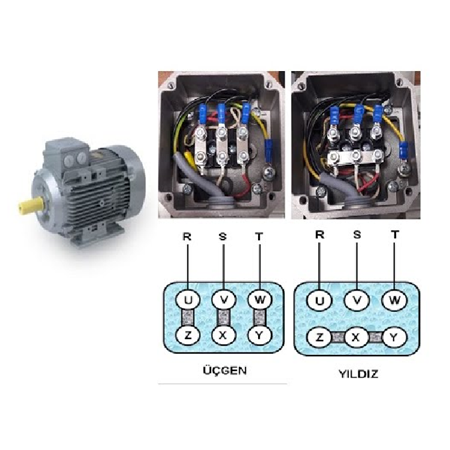
Star (Y) and delta (Δ) are the two common winding connection arrangements used with three-phase AC motors. They change the relationship between line voltage, phase voltage and winding current, which directly affects motor starting current and torque.
What is a star connection?
In a star connection, one end of each of the three windings is joined to a common star point. The line conductors connect to the other ends of the windings.
For a balanced three-phase star connection:
- Phase voltage = Line voltage / √3
- Line current = Phase current
Because each winding receives a lower voltage than the line-to-line supply voltage, a motor that is suitable for star-delta starting produces reduced current and reduced torque while connected in star.
What is a delta connection?
In delta, the windings are connected end-to-start to form a closed triangular loop. Each winding is connected directly across the line-to-line voltage.
For a balanced delta connection:
- Phase voltage = Line voltage
- Line current = √3 × Phase current
Star vs delta at a glance
| Property | Star (Y) | Delta (Δ) |
|---|---|---|
| Winding voltage | Line voltage / √3 | Line voltage |
| Line current relationship | Same as phase current | √3 × phase current |
| Starting current | Lower when used in star-delta starting | Higher at full line voltage |
| Starting torque | Lower | Higher |
How star-delta starting works
For motors specifically designed to run in delta at the available line voltage, a star-delta starter can initially connect the windings in star. This reduces the voltage across each winding during acceleration. After the motor reaches sufficient speed, the starter changes the winding connection to delta for normal running.
Compared with direct-on-line starting, the idealized line starting current in star is approximately one-third of the delta starting current, and starting torque is also approximately one-third. Actual values depend on the motor and load.
When is star-delta starting suitable?
It is most suitable when the driven load can accelerate with reduced starting torque. Examples may include unloaded or lightly loaded pumps, fans and machinery with low starting resistance.
It is not suitable where the load requires high breakaway torque from zero speed.
Read the motor nameplate first
Typical nameplates may show voltage pairs such as 230/400 V Δ/Y or 400/690 V Δ/Y. These markings specify the winding connection appropriate to different line voltages.
For example, a 400/690 V Δ/Y motor is generally intended to run in delta on a 400 V three-phase supply and in star on a 690 V supply. Such a motor may be suitable for conventional star-delta starting on a 400 V system if the application and starter are designed for it.
Why incorrect connection is dangerous
Applying too much voltage to a winding can cause excessive current and overheating. Using the wrong connection can also produce inadequate torque, unstable acceleration or protection trips.
Star-delta versus VFD starting
A variable-frequency drive can control motor voltage and frequency during acceleration, providing a more flexible starting profile and speed control. Star-delta starting is simpler, but it creates a discrete transition between winding configurations and does not provide variable-speed operation.
Safety
Three-phase motor wiring involves hazardous voltages. Isolation, lockout/tagout, verification of zero energy and correct protection are essential. Connection changes should be performed by qualified personnel using the motor documentation and applicable electrical standards.